Germantown Medical Guide 2024
On certain Friday mornings, Batman gets a bath and good brushing before he picks up a shift at Baptist Medical Group Outpatient Care Center. The six-year-old German Shepherd volunteers in the newly redesigned pediatric department working with speech therapy patients. Batman loves squeaky toys, but his favorite activity is playing ball, according to his trading card. San Chambers, his handler, gives out the cards to anyone who pets him, along with a squirt of hand sanitizer from a bottle labeled “dog slobber.”

“It’s empowering for children to use words and be the boss of this big dog,” says Chambers, a registered handler for Mid South Therapy Dogs for 10 years. Batman is her second trained Shepherd. After identifying the daily skill with therapists, Chambers incorporates play-based interaction with children working on communication.
Justin Hall, Pediatric Rehabilitation Manager for the center, says animal assisted therapy is great for kids working to string together two-word phrases. “They pronounce commands like ‘Roll ball’ or ‘Catch ball,’ and get excited when the dog obeys.”
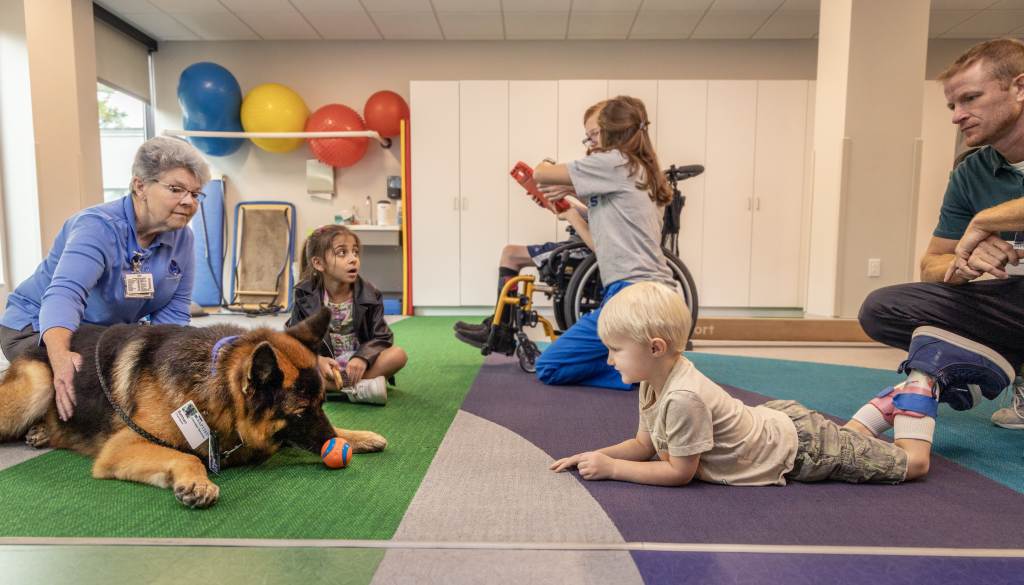
For a two-year-old patient learning to make the “S” sound, Batman sits. He stays. He leaves a treat on the floor until given permission to gobble it up. With a timid girl learning to name her colors, Batman lies still while she brushes the brown part of his coat, then spots of black fur.
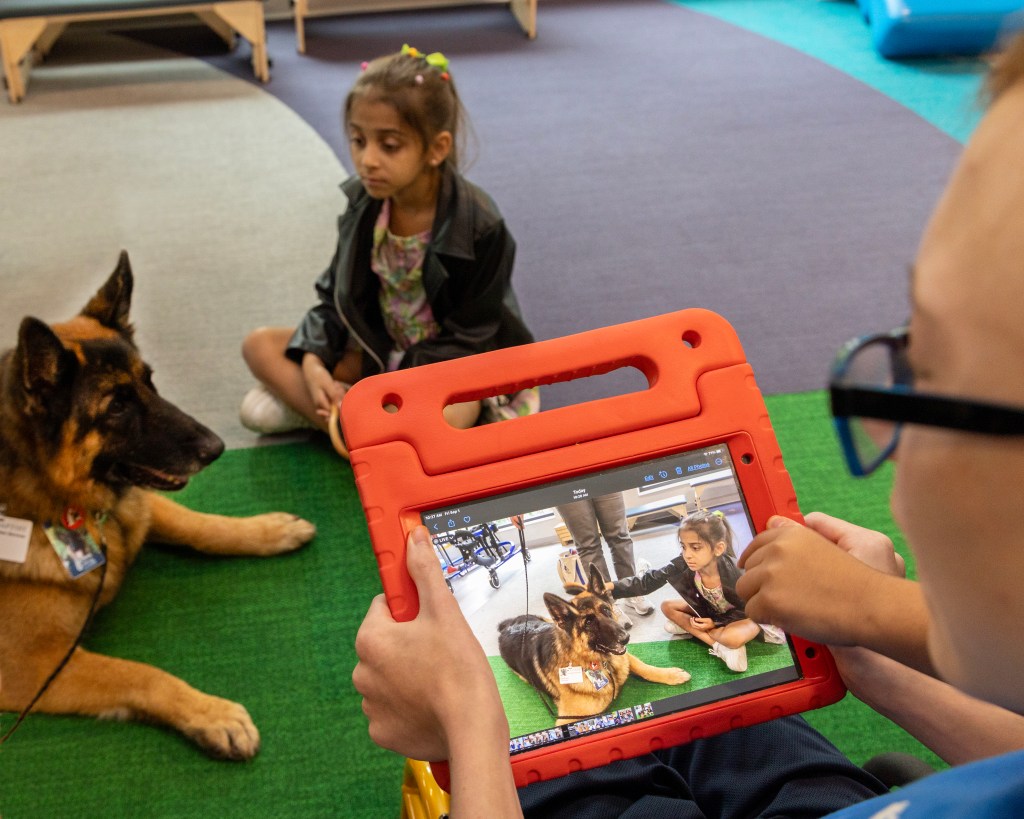
In occupational therapy sessions, he stands regal and proud as little hands put scrunchies on his ears and tail, making fine motor-skills practice into a fun game of doggie dress up. Batman even has a work vest hand-sewn by a member of MSTD, complete with laces, buckles and buttons for patients to practice fastening.
“We try to take what the dog loves and what the therapist is working on to come up with activities that motivate patients,” says Chambers. “Batman loves the ball. I didn’t teach him to push it across the floor gently like that. He sees a small kid, and that’s his own calm, playful game. It’s all him.”
Training on both ends of the leas
Different animals have different job classifications according to the American Kennel Club. Service dogs are certified to help a specific person with a disability such as visual impairment, diabetes or seizures. Therapy dogs are trained to visit clinical settings like hospitals, schools and assisted living facilities to provide comfort and affection to many different people.
“The best therapy animals have a naturally calm demeanor, love human interaction and are comfortable in unfamiliar settings,” says Mary Ehrhart, Executive Director of MSTD.
Since it opened in 1999, each team, meaning dog and handler, undergoes a detailed qualifying process involving interviews and screening, workshops and competency-based evaluations. All 30 of the current MSTD therapy dogs are trained, insured and licensed by the nonprofit. Teams meet rigorous standards and get reevaluated every two years.
Helping humans in need
From hospice to acute care facilities, MSTD therapy animals work in the environments they are most comfortable. “Our priorities are always to make sure the dog is safe and happy,” Chambers explains. “We put each one in a position to shine.”
MSTD also assists in educational settings. For the Reading Education Assistance Dogs (R.E.A.D.) program, teams visit schools and libraries where the dogs snuggle down for young children to read stories aloud. During finals week and board exams, teams provide “stress-free zones” at local universities and medical schools where students can pet pups to unwind.
Every year, several teams attend Camp Good Grief where oftentimes dogs form a bond with a grieving child in a way human volunteers cannot.
Hard at work
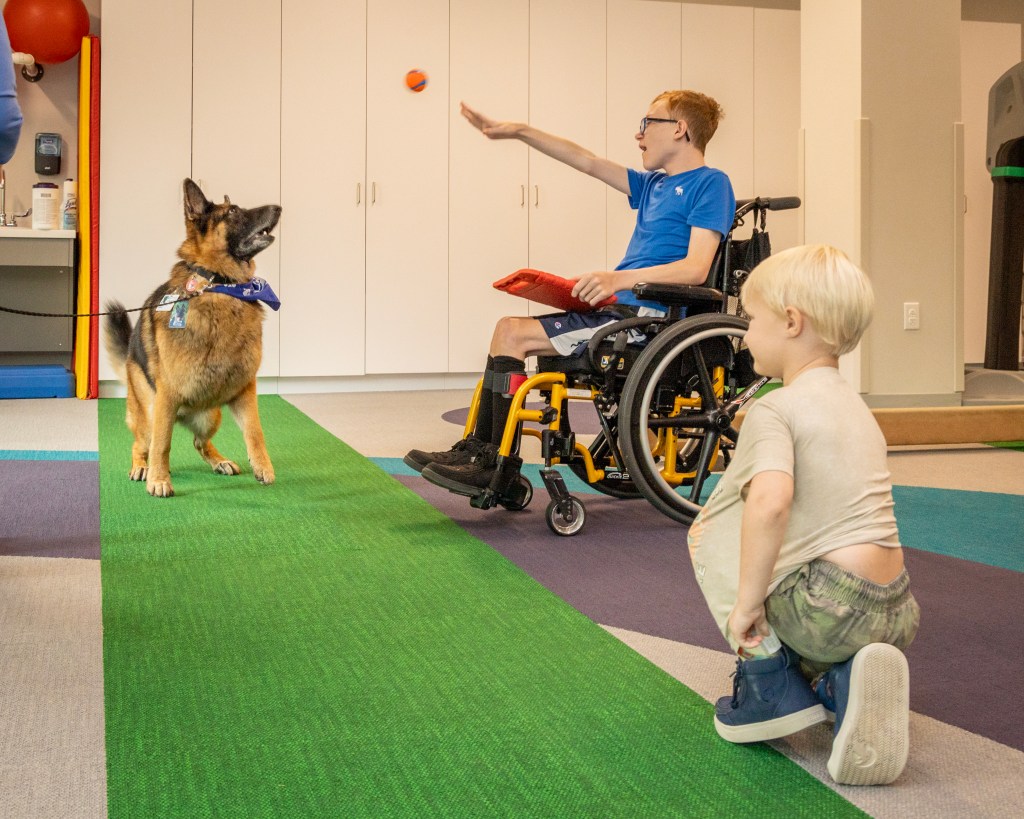
Batman works two days a week in two-hour shifts. It requires much effort and energy to assist so many people with unfamiliar smells and loud noises. His last patient of the day, a happy redhead named Lucas, is nonverbal and uses a device to communicate by choosing pictures on a screen.
“I. Want. Throw. Batman. Ball. Please.”
Batman places the ball in his patient’s lap and sits back to wait as Lucas scoops it carefully with one hand. Chambers encourages the therapists, parents and kids to count together. “One, two, three.” Lucas launches the ball which makes a high bounce off the floor. Batman jumps and catches it in the air.
Everyone cheers and pets him one last time before the session ends. Chambers hands out trading cards and squirts of dog slobber.
Lucas taps on his device, “Goodbye. Batman.” When he raises a hand in the air, Batman sits and waves a paw. Good boy.
 Candice Baxter